How to Control Japanese Beetles
Stop Japanese beetles from destroying your roses and garden. Identification, organic controls, and long-term grub prevention that actually work.
Key takeaways
- Hand-picking beetles into soapy water at dawn is the most effective immediate control
- Japanese beetle bag traps attract more beetles than they catch - do not use them
- Milky spore powder kills grubs in your lawn for 10-15 years after a single application
- Neem oil spray deters feeding and disrupts the beetle life cycle
- Beetles are most active from late June through August across most of the eastern US
Identifying Japanese beetles
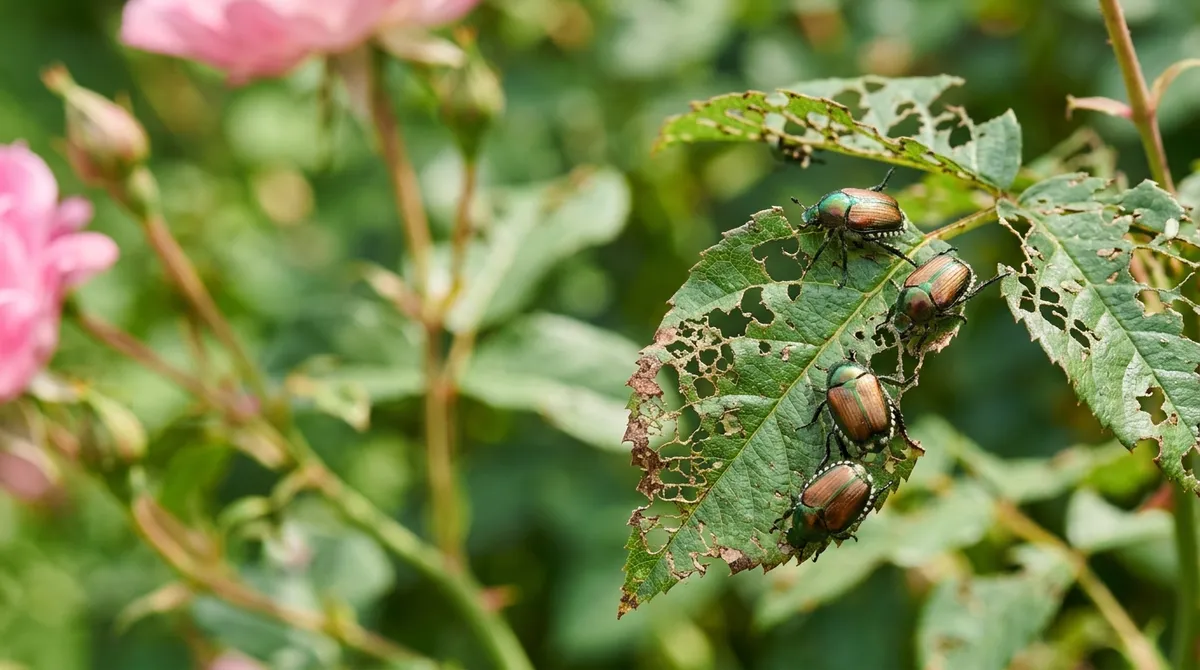
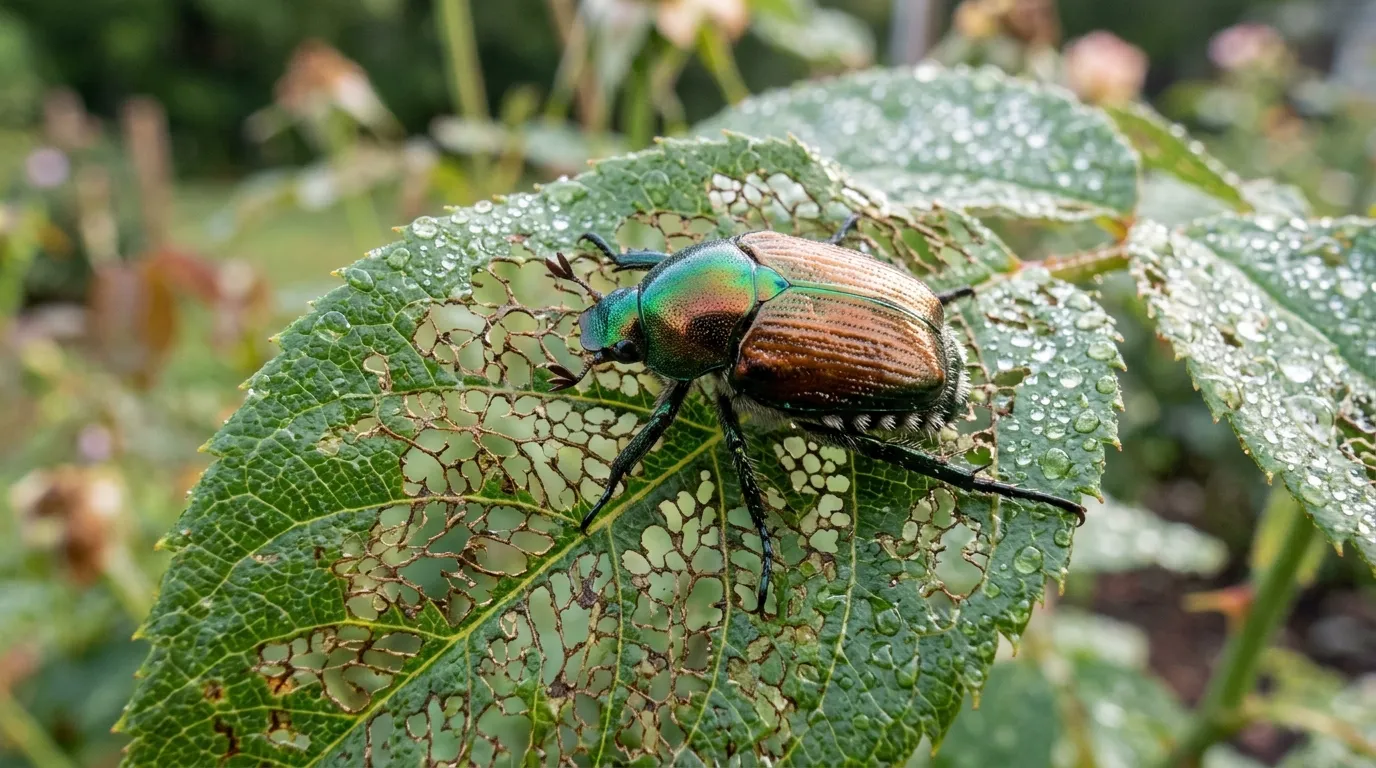
Japanese beetles are hard to mistake for anything else. Adults are about half an inch long with a metallic green head and thorax and copper-brown wing covers. Look for the row of five white hair tufts along each side of the abdomen and two tufts at the tail end. No other common garden beetle in the US has this exact combination.
The larvae are C-shaped white grubs found 2-4 inches below the soil surface in lawns. They feed on grass roots from late summer through the following spring. If you can pull up patches of your lawn like a carpet in September, grubs are likely the cause.
Japanese beetles first arrived in the US in 1916 in a shipment of iris bulbs to New Jersey. They now infest lawns and gardens in more than 30 states, primarily east of the Mississippi River, with populations spreading into Colorado, Utah, and Oregon.
The Japanese beetle life cycle
Understanding the life cycle tells you when and where to attack. Japanese beetles spend 10 months underground as grubs and only 6-8 weeks above ground as adults.
Late June - early August: Adults emerge from the soil, feed on plants, and mate. Females return to the soil every few days to lay 40-60 eggs total over their adult life.
August - September: Eggs hatch into tiny grubs that feed on grass roots near the surface. This is when lawn damage appears.
October - March: Grubs burrow 4-8 inches deep to overwinter below the frost line. They are dormant and unreachable during this period.
April - May: Grubs move back to the surface and resume feeding on roots for a few weeks before pupating.
June: Pupae transform into adults, and the cycle repeats.
| Life stage | Timing | Location | Vulnerable to treatment |
|---|---|---|---|
| Eggs | Jul - Aug | Soil, 2-3 in deep | Not treatable |
| Young grubs | Aug - Sep | Soil, 1-2 in deep | Nematodes, milky spore |
| Overwintering grubs | Oct - Mar | Soil, 4-8 in deep | Not reachable |
| Spring grubs | Apr - May | Soil, 1-2 in deep | Nematodes, milky spore |
| Pupae | Late May - Jun | Soil, 2-4 in deep | Not treatable |
| Adults | Late Jun - Aug | Above ground on plants | Hand-picking, neem oil |
Hand-picking: the best immediate control
Hand-picking beetles is the most effective way to reduce damage to your plants right now. It sounds tedious, but it works faster than any spray.
Go out at dawn, around 6-7 AM, when beetles are cold and sluggish. They sit still on leaves and drop easily. By mid-morning they warm up and fly away when disturbed.
Carry a bucket of water with a squirt of dish soap. Knock beetles off leaves directly into the bucket. The soap breaks the surface tension so beetles sink and drown instead of crawling back out.
A single morning patrol takes 10-15 minutes for an average garden and removes dozens to hundreds of beetles. Do this daily during peak season (late June through July) and you will see a noticeable reduction in damage within a week.
Japanese beetles release aggregation pheromones that attract more beetles to plants where others are already feeding. Removing beetles early in the morning, before feeding begins, reduces the chemical signal that draws in reinforcements.
Neem oil and organic sprays
Neem oil is the best organic spray option for Japanese beetles. It works in two ways: as a feeding deterrent and as a reproductive disruptor.
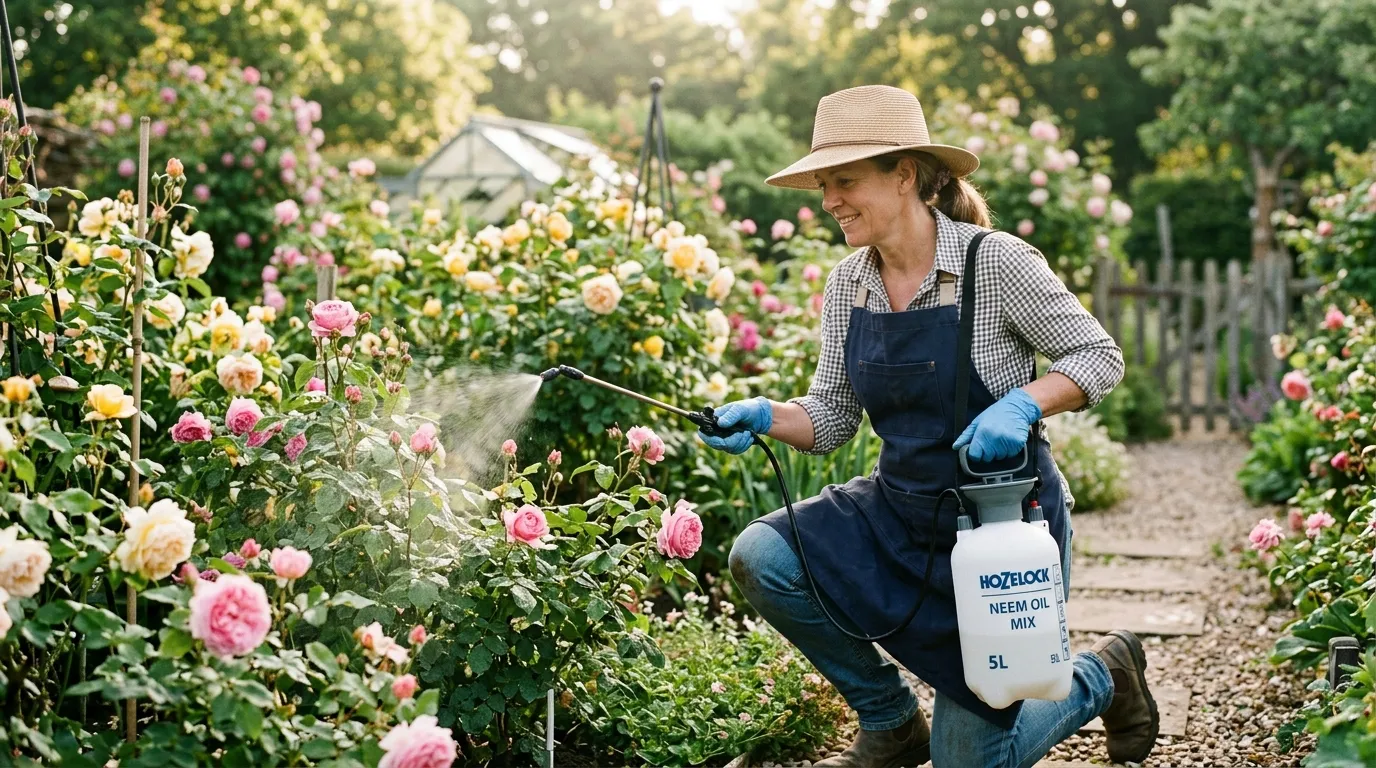
How to apply: Mix cold-pressed neem oil at 2 tablespoons per gallon of water with a few drops of liquid soap as an emulsifier. Spray all leaf surfaces, top and bottom, in the early morning or evening. Reapply every 7-10 days and after rain.
Neem does not kill beetles on contact. Instead, beetles that feed on treated foliage eat less, mate less successfully, and lay fewer viable eggs. The effect is cumulative over the season.
Kaolin clay (sold as Surround WP) creates a white film on leaves that confuses and deters beetles. It works well on vegetables and fruit trees but leaves a visible residue that some gardeners dislike on ornamentals.
Pyrethrin sprays derived from chrysanthemum flowers kill beetles on contact but also kill beneficial insects including bees and ladybugs. Use pyrethrins only as a last resort and never spray open flowers.
| Treatment | How it works | Reapply frequency | Safe for bees | Cost per season |
|---|---|---|---|---|
| Neem oil | Deters feeding, disrupts reproduction | Every 7-10 days | Yes, if applied at dawn | $15-25 |
| Kaolin clay | Physical barrier, confuses beetles | Every 7-14 days | Yes | $20-30 |
| Pyrethrin | Contact kill | After each rain | No | $15-20 |
| Spinosad | Ingestion kill | Every 7 days | No, toxic to bees for 3 hours | $12-18 |
Long-term grub control
Killing adults is a short-term fix. For lasting control, you need to break the life cycle by targeting grubs in the soil.
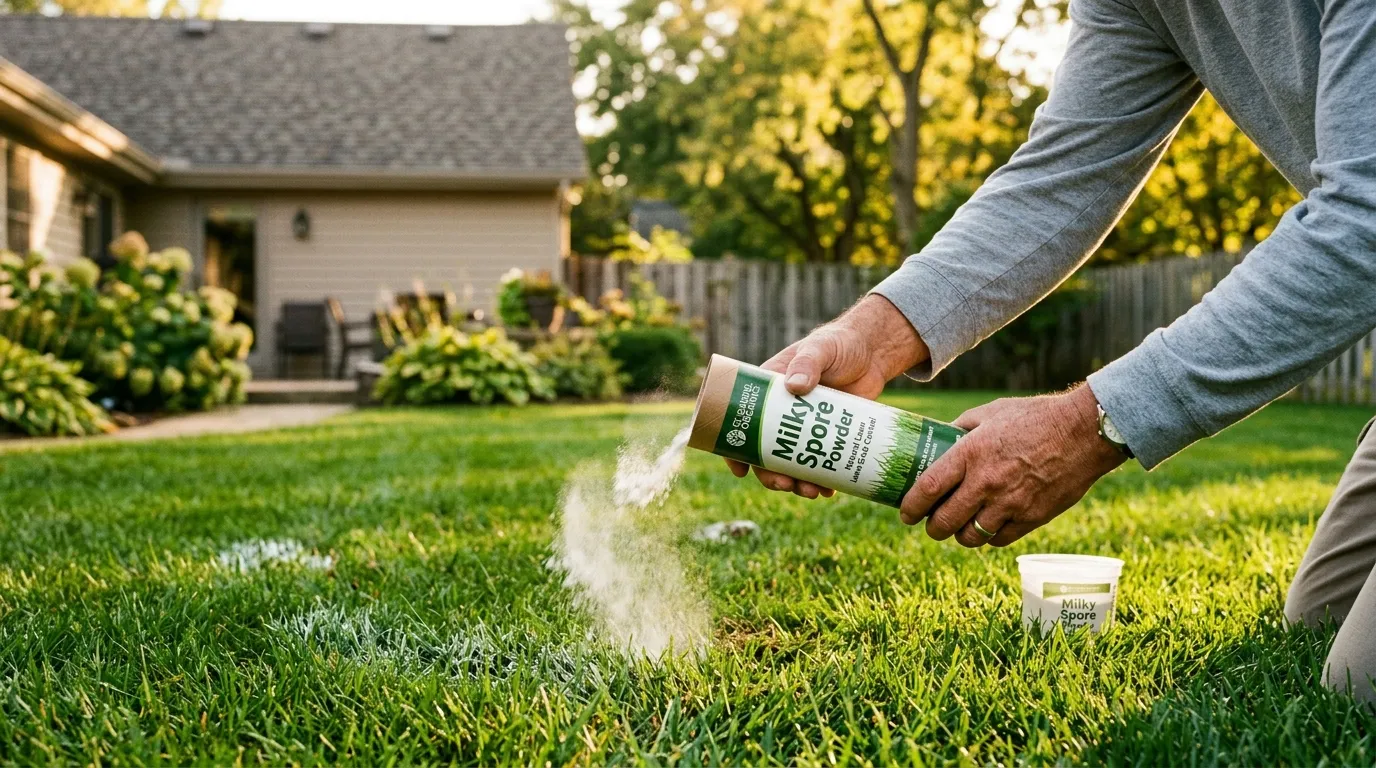
Milky spore powder (Paenibacillus popilliae) is a naturally occurring bacterium that infects and kills Japanese beetle grubs. Apply it to your lawn in late summer or early fall when young grubs are feeding near the surface. The spores multiply inside dead grubs and persist in the soil for 10-15 years, providing ongoing protection. One application handles the problem for a decade or more.
Milky spore takes 2-3 years to build up to full effectiveness. During that time, continue hand-picking adults and using neem oil.
Beneficial nematodes (Heterorhabditis bacteriophora) are microscopic worms that hunt and kill grubs in the soil. Apply them in late August through September when soil temperature is between 60-80F and soil is moist. Water the lawn before and after application.
Nematodes work faster than milky spore, often reducing grub populations by 50-80% in the first season. However, they do not persist as long and may need reapplication every 1-2 years.
Combination approach: Apply milky spore for long-term protection and nematodes for immediate grub reduction in year one. By year three, the milky spore is established and works on its own.
What NOT to do
Some popular Japanese beetle control methods are ineffective or actively make the problem worse.
Japanese beetle bag traps are the biggest mistake gardeners make. These traps use floral and sex pheromone lures that attract beetles from up to a quarter mile away. University of Kentucky research found that traps draw 5-10 times more beetles into your yard than they capture. The beetles that miss the bag land on your plants instead. If your neighbor uses bag traps, your garden pays the price.
Treating grubs with chemical insecticides like imidacloprid (a neonicotinoid) kills grubs effectively but also kills beneficial soil organisms, contaminates groundwater, and is highly toxic to bees. Organic alternatives work just as well without the collateral damage.
Ignoring the problem and hoping beetles will not come back does not work. Female beetles lay eggs in the same area where they fed as adults. Without intervention, populations build each year.
Removing all host plants is impractical. Japanese beetles feed on over 300 plant species. You cannot eliminate every target. Focus on protecting your most valuable plants with hand-picking and neem oil while breaking the life cycle with grub treatments.
Plants beetles love and hate
Japanese beetles have strong preferences. Knowing what they target helps you plan your garden and prioritize protection.
Favorites they devour: Roses, Japanese maples, lindens, grapes, raspberries, crabapples, birch, and crape myrtles attract beetles from across the neighborhood. Protect these with neem oil and morning hand-picking.
Plants they avoid: Boxwood, red maple, holly, magnolia, dogwood, forsythia, lilac, and most conifers are rarely damaged. Planting these near vulnerable species does not repel beetles, but replacing heavily damaged ornamentals with resistant alternatives reduces your workload.
Trap crops are plants you sacrifice to draw beetles away from your prized specimens. Geraniums are a natural trap crop. Japanese beetles that eat geranium petals become paralyzed and fall off the plant, making them easy to collect. Plant geraniums near your roses and check them for dizzy beetles each morning.
Sarah Mitchell is a Master Gardener and garden writer based in the Pacific Northwest. She has been growing food and flowers for over 15 years across USDA zones 7 and 8.